
A tour focused on provisioning and diagnostics
See charger provisioning in ChargeControl
Choose a time with our team and focus on commissioning, protocol support, and remote diagnostics.
Schedule a demoFor installers and technical partners
Provision and commission chargers with interoperable protocols, then diagnose and support them without another site visit for routine issues.
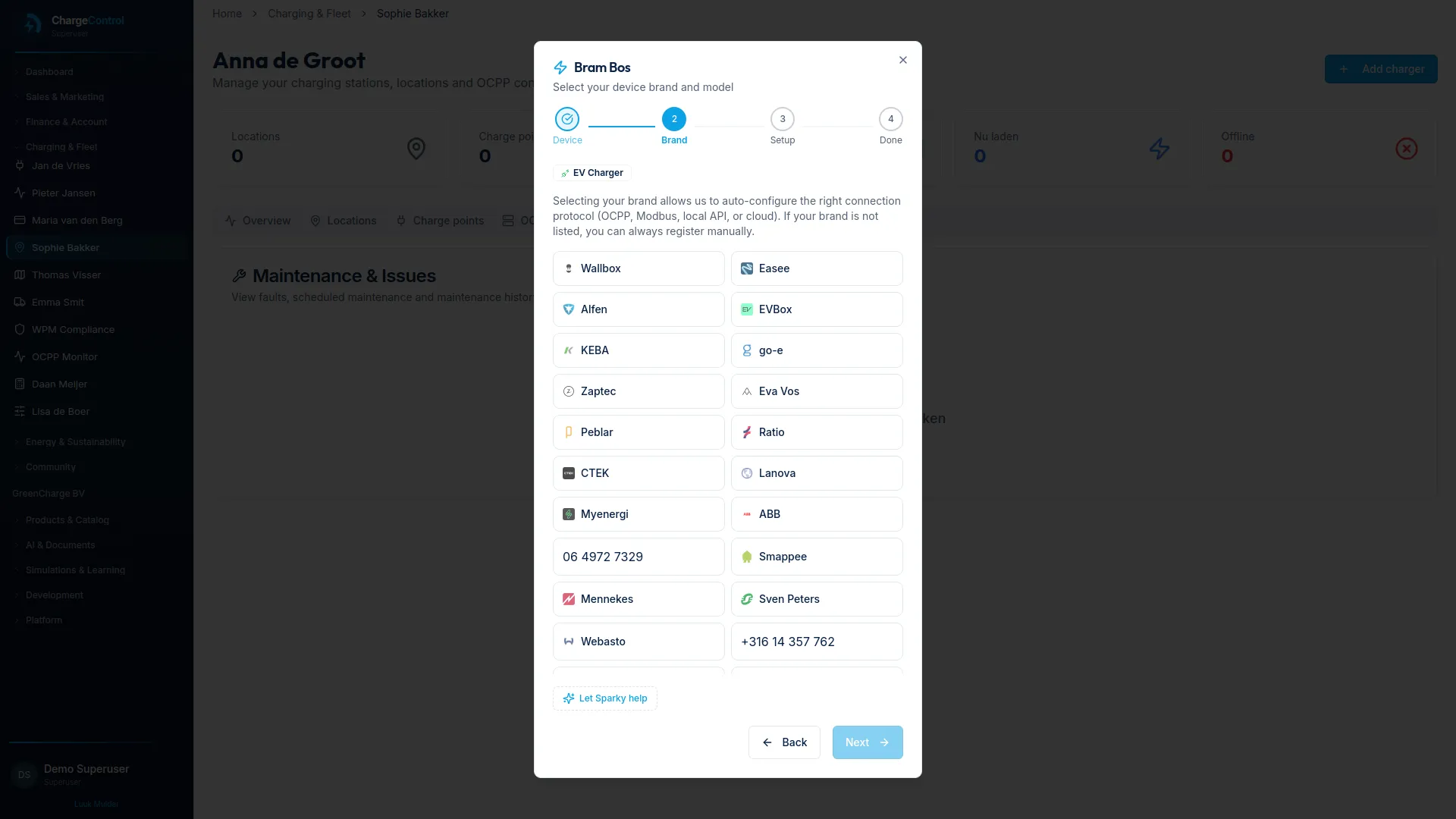
Installers often lack a way to confirm charger health or diagnose issues once a job is done, which means routine problems still need a return visit. ChargeControl supports provisioning and commissioning across mixed hardware with interoperable protocols, then keeps charger status visible for remote diagnostics afterward.
That means installer work hands off cleanly to operations, and fewer issues require getting back in the van.
Installers frequently lack the tools to confirm a charger is working correctly after leaving the site, or to diagnose issues remotely.
Bringing a new charger online can involve manual configuration steps that vary by hardware.
Confirming charger health after installation often requires a return site visit.
Different charger models and protocols make consistent provisioning harder to standardize.
It is not always clear who owns a charger once installation is complete.
A consistent path from commissioning to remote support across mixed hardware.
Bring a new charger online using interoperable protocols such as OCPP.
Set site-level parameters like capacity limits and access rules during commissioning.
Confirm the charger reports status and session data correctly before leaving the site.
Transfer ownership to the fleet or facility team once commissioning is confirmed.
Investigate charger status and connectivity issues without a site visit for routine cases.
The ChargeControl capabilities that support commissioning and ongoing charger support.
Shows where charger provisioning fits within the wider ChargeControl platform.
Applies site capacity and load settings configured during commissioning.
Connects provisioning and diagnostics workflows to the systems you already use.
Supports protocol-level integration work for provisioning and diagnostics.
A ChargeControl view that keeps charger status and connectivity visible from provisioning onward.
Confirm a charger reports status correctly before ending the site visit.
Investigate status and connectivity issues without scheduling a return visit for every case.
See when a charger has moved from commissioning into regular operational use.
Provisioning goes smoother when protocol support, site configuration, and handoff steps are clear before work begins.
Confirm which protocols the charger hardware and ChargeControl setup support.
Set capacity, access, and energy parameters as part of commissioning.
Confirm connectivity and session reporting before leaving the site.
Agree on who owns the charger and its support path after commissioning.
The outcomes installers need as the number of sites and chargers grows.
The same commissioning steps apply across mixed hardware and sites.
Remote diagnostics resolve some issues without a repeat site visit.
Handoff steps keep responsibility clear as more chargers move into operation.
Interoperable protocols keep provisioning workable across different hardware vendors.
ChargeControl supports interoperable protocols such as OCPP, OCPI, ISO 15118 Plug & Charge, Modbus, and EEBus. The exact protocol mix depends on your hardware and is confirmed during implementation.
Many connectivity and status issues can be investigated remotely. Some hardware-level issues may still require a site visit.
Yes. ChargeControl is designed for mixed environments, though the exact device mix is confirmed during implementation planning.
Ownership typically transfers to the fleet or facility team once commissioning is verified. The exact handoff process is agreed during implementation.
Some provisioning workflows use APIs and protocol-level integration. Developer documentation is available for teams that need it.
Typical work includes confirming protocol support, agreeing on site configuration standards, and defining the handoff process to operations.
A tour focused on provisioning and diagnostics
Choose a time with our team and focus on commissioning, protocol support, and remote diagnostics.
Schedule a demoPrefer a conversation?
Tell us about your installation and commissioning process and we will follow up with the right ChargeControl specialist.
Request a callbackWe respect your privacy. No spam, ever.