
A tour focused on cost and settlement
See charging cost reporting in ChargeControl
Choose a time with our team and focus on settlement accuracy, accounting integration, and audit needs.
Schedule a demoFor finance and tax teams
Turn charging sessions into accurate, auditable reimbursement and cost data connected to the accounting systems you already use.
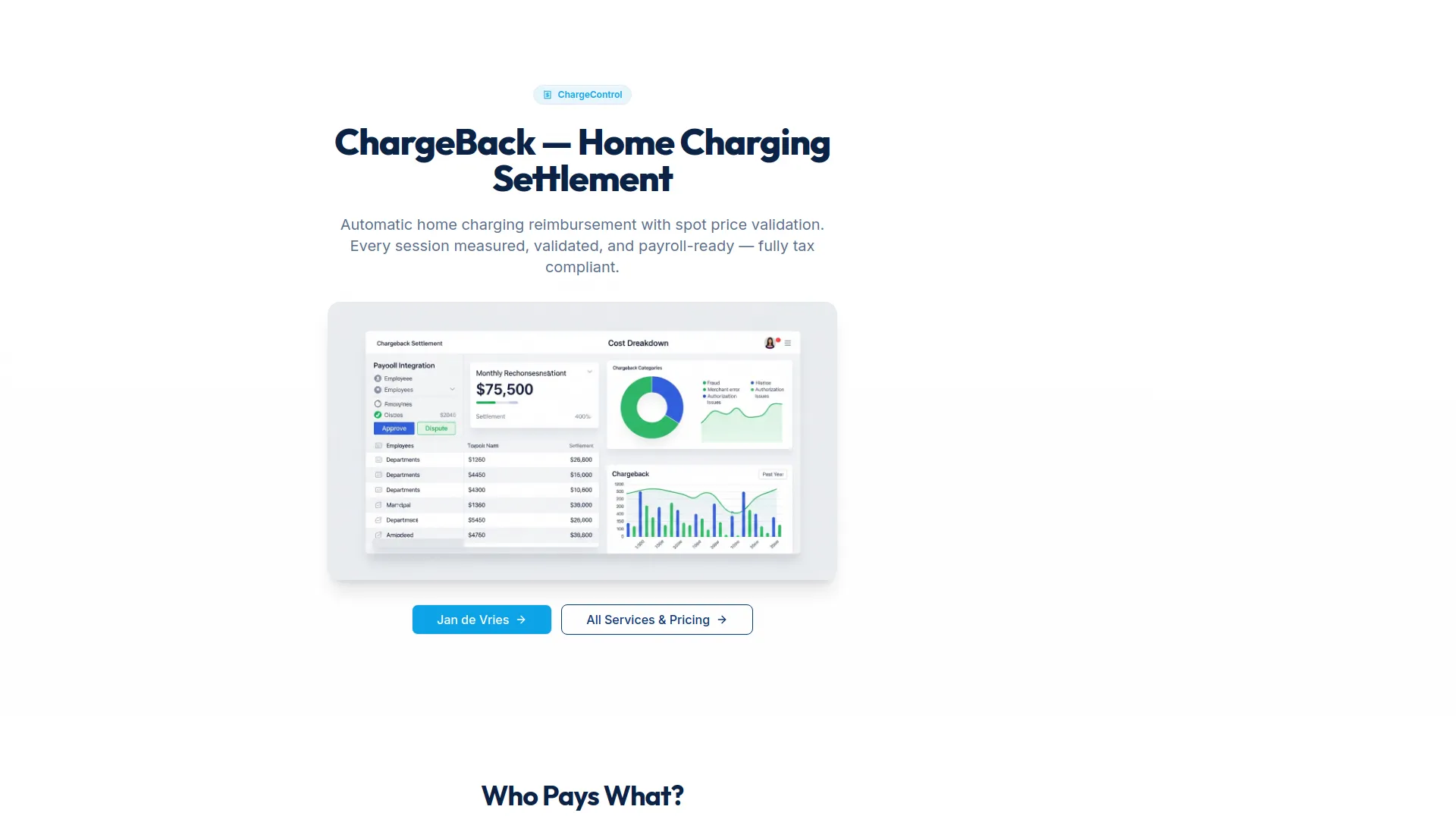
Charging cost data often arrives incomplete or hard to reconcile, which slows down settlement, accounting, and audits alike. ChargeControl connects session data, reimbursement policy, and ChargeBack settlement into one traceable dataset, so finance and tax teams do not have to reconstruct the calculation behind every cost.
That means accounting handoffs move faster, and audit questions have a clear trail to follow instead of a spreadsheet to rebuild.
Finance and tax teams often inherit charging cost data that is incomplete, inconsistent, or hard to trace back to a session.
Session data, invoices, and reimbursement amounts do not always line up without manual checking.
It can be hard to confirm that a reimbursed amount actually followed company policy.
Moving settled charging costs into accounting systems often relies on manual exports.
Reconstructing the trail behind a charging cost can take longer than it should during a review.
A traceable path from session data to accounting-ready charging costs.
Bring home, workplace, and public charging session data into one dataset.
Calculate reimbursement using the rates and rules finance and fleet teams define together.
Turn session data into settled reimbursement amounts with a clear calculation trail.
Move settled costs into the accounting or ERP systems finance already uses.
Trace any reimbursed amount back to the session and policy that produced it.
The ChargeControl capabilities that connect charging activity to accurate, traceable cost data.
Calculates and settles reimbursement for home and workplace charging.
Provides consistent cost and session data across charging domains.
Connects settlement data to accounting, ERP, and billing systems.
Places charging costs inside the broader fleet operating picture.
A ChargeControl view that keeps session data, cost calculations, and settlement together for finance and tax teams.
Trace settled amounts back to the session and policy that produced them.
Work from the same session and cost dataset as fleet and HR teams.
Move settled costs into accounting systems without manual reformatting.
Charging cost reporting works best when policy, accounting integration, and audit needs are confirmed early.
Confirm reimbursement rates and rules before sessions start settling.
Connect settlement output to the ERP or accounting systems finance already uses.
Confirm what evidence and traceability audits or tax reviews will expect.
Agree on how often settled cost data should be reviewed and exported.
The outcomes finance and tax teams need as charging volume grows across domains.
Automated settlement reduces the manual checking that grows with session volume.
The same calculation logic applies across home, workplace, and public charging.
Settled costs reach accounting systems in a form that does not require rework.
Traceability holds up as charging volume and driver count increase.
ChargeBack applies the reimbursement rates and rules your organization configures. Tax treatment follows your own policy and advice, confirmed during implementation.
ChargeControl supports integrations with accounting, ERP, and billing systems through REST, GraphQL, and webhooks. Specific connectors are scoped during implementation.
Every settled amount is linked to the session and policy that produced it, so finance and audit teams can trace it without rebuilding the calculation by hand.
Yes. Session and cost data from each domain feed into the same reporting and settlement process.
Typical work includes confirming rates and policy, connecting accounting systems, and agreeing on reporting cadence and audit requirements.
Session data comes directly from connected chargers and meters rather than manual entry, though data quality still depends on your connected hardware and integrations.
A tour focused on cost and settlement
Choose a time with our team and focus on settlement accuracy, accounting integration, and audit needs.
Schedule a demoPrefer a conversation?
Tell us about your charging cost reporting needs and we will follow up with the right ChargeControl specialist.
Request a callbackWe respect your privacy. No spam, ever.